Lifestyle Blog Tupersonalshopperviajero : 1/8/08 - 1/9/08

Cardiff ciudad moderna y centenaria

bandera-cardiff
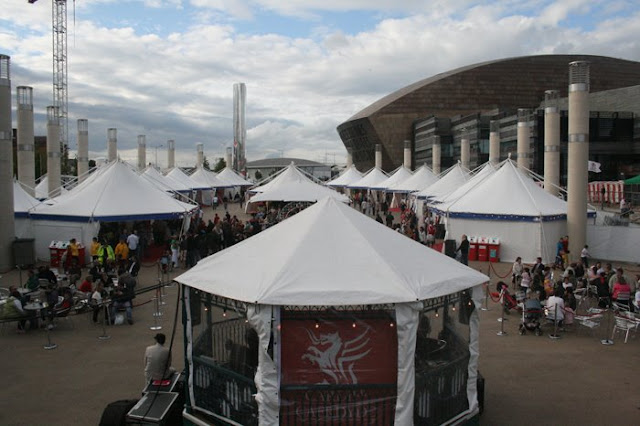
Cardiff romana, normanda, arquitectónicamente grandiosa, puerto carbonero, comercial y turística. Ciudad moderna y centenaria que en 1955 fue ratificada como la primera capital de Gales. Verdaderamente, no tiene desperdicio. Si quieres historia te vas al centro, repleto de calles y jardines victorianos y eduardianos donde habita un castillo neogótico y edificios civiles neoclásicos, amén de galerías comerciales -las más antigua es la Royal Arcade de 1856- y un mercado cubierto que data del s.XIX. Pero si lo que buscas es su parte más moderna, cruzas hacia el sur de la ciudad buscando el Puerto donde confluyen el Wales Millenium Centre, sede de la Welsh National Opera; el Techniquest, o museo de la ciencia; el BayArt Gallery, con exposiciones y venta de productos manufacturados locales ;o el centro de visitantes Cardiff Bay Visitors´Centre. Pero en cada extremo hay elementos compensatorios. Así, en el centro histórico se produce el equilibrio con el moderno Millennium Stadium, sede del equipo de rugby Welsh y donde Madonna ha iniciado su gira mundial, y en la bahía está la Norwegian Church de madera, erigida en 1868 para los marineros normandos que traían material a las minas de carbón del sur de Gales. Cuando estuvimos allí había una especia de feria de muestras en su bahía con degustaciones de productos de varios lugares del mundo. Allí descubrí lo que nunca antes había probado: el queso cheddar galés incrustado de trocitos de frambuesa. Para morirse del gusto!!! También nos traímos unas botellitas de la tradicional cidra, que se elabora en las granjas del lugar en Ralph´s Cider and Perry, de manzana y de pera.

🔼🔽🔼🔽🔼🔽🔼🔽🔼🔽


A city with category. Roman, Norman, architectonically grand, miner port, commercial and tourist city that in 1955 was ratified as the first capital of Wales. All this and more is Cardiff.

It doesn´t have any waste. If you want the historical city you go away to the center, which is completely filled with Victorian and Eduardianos gardens and streets where it is a Neogothic Castle and civil neoclassic buildings, amen of shopping centers - the most ancient is The Royal Arcade of 1856- and one covered market that dates back from the XIXth century. Otherwise, if you are looking for the modern city, you cross towards the south to meet the Port where they come together: the Wales Millenium Centre, the Welsh National´s headquarter; the Techniquest, or Science´s Museum; the BayArt Gallery, with exhibitions and sale of manufactured local products; or the Cardiff Bay Visitors' CentreBut in every end there are compensatory elements. This way, in the historical center the balance takes place with the modern Millennium Stadium, headquarter of the Welsh rugby team and where Madonna has initiated her world tour. In the bay, the compensatory element, is the Norwegian Church made of wood, and raised in 1868 for the Norman sailors who were bringing material to the coal mines of the south of Wales. When we were there there was a trade fair in the bay with products degustations of several places around the world. There I discovered what I had never tried before: the Welshman cheddar cheese incrusted with bits of raspberry. To die of the taste!!! We also bought a few bottles of the traditional cider elaborates in the in Ralph's Cider local farms.

** More pics and videos / Mas fotos y vídeos en mi Instagram **


cardiff


Wales-Millenium-Centre

Techniquest

BayArt Gallery

Cardiff-Bay-Visitors-Centre


feria-de-muestras


feria-de-muestras-en-cardiff


cidra-de-cardiff

castillo-de-cardiff

castillo-de-cardiff

castillo-de-cardiff

El Castillo de Cardiff


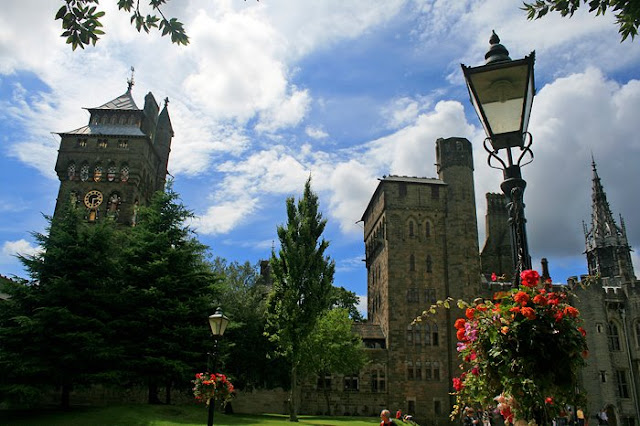
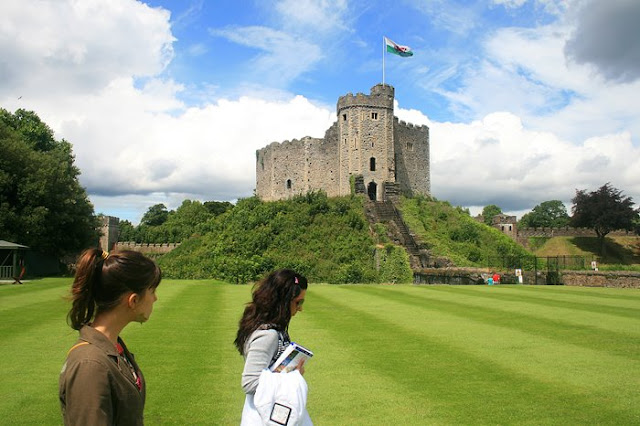
Primero fue una fortaleza romana, cuyos restos están hoy día separados de la parte moderna del castillo por un muro de piedra roja. En el s.XII se construyó se construyó una torre dentro de las ruinas romanas y 700 años más tarde el castillo va de mano en mano hasta llegar a las del acaudalado John Stuart en 1776, hijo del conde de Bute que mandó construir una maravillosa mansión de aspecto medieval y romántico -que lamentablemente no te dejan fotografiar cuando haces la visita. Un fastidio vamos-; y de la que el Salón de Fumar de Verano, el Salón de Banquetes, la Terraza y la Biblioteca son sus hits.

Cardiff ´s Castle


First at all it was a Roman fortress, which remains are separated today from the modern part of the castle by one red stone wall. In the XIIth a tower was constructed inside the Roman ruins and 700 years later the castle goes of hand in hand up to there coming to those of the wealthy John Stuart in 1776, count of Bute´s son who gave the orders to construct a wonderful mansion of medieval and romantic aspect - that lamentably they do not leave you to come out in photographs when you do the visit. A nuisance we go-; The Smoking Summe´s lounge, the Banquets´lounge, the Terrace and the Library are the castle´s hits.

fortaleza-romana

fortaleza-romana-cardiff

fortaleza-romana


ciudad-de-cardiff

¡De compras!

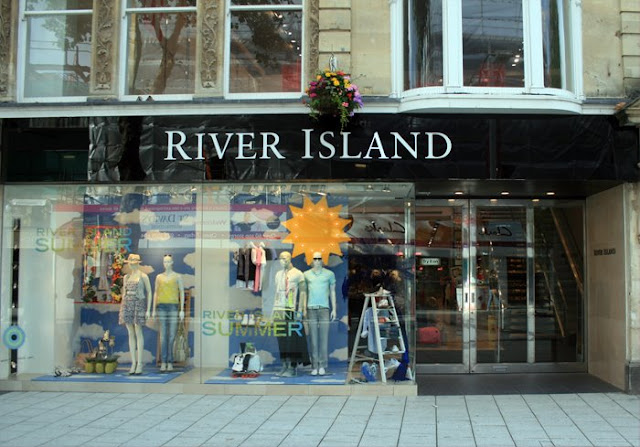
Como no podía ser de otra manera, hubo tiempo para visitar tiendas: New Look, Primark, River Island, Top Shop... Os muestro los dos bolsos que me traje. El de rayas de River Island - de esa tienda me lo hubiese llevado todo- y el tricolor de Primark.

Shopping


There were time for shopping. I got this two purses from River Island -the stripped one- and the tricolour from Primark.


River-Island-en-cardiff

bolso-de-river-island

bolso-de-primark


¿Te ha gustado el post? dale aDo yo like the post? Click G+1 ¡Thanks!

          Photos: David Sánchez Núñez

Stay in touch!


FACEBOOK  BLOGLOVIN  PINTEREST  TWITTER  INSTAGRAM G+


7 cosas que no te puedes perder en Bath

minerva-tuvo uno-de-sus-templos-en-bath-somerset-reino-unido

Después de Stonehenge fuimos a conocer Bath, ciudad declarada Patrimonio de la Humanidad por la UNESCO merecidamente- es de los lugares más bellos que he visitado en Inglaterra. Empezamos por sus termas romanas para contarte lo que no te puedes perder de esta ciudad:

STONEHENGE, SALISBURY Y CHEDDAR

pasear-por-STONEHENGE
Stonehenge está ubicado en una llanura del condado de Wiltshire (Salisbury) y es, sin duda, el monumento prehistórico más famoso de Europa. Con sus 5.000 años de antigüedad, ha sabido rodearse de un halo de misterio y a pesar de los numerosos estudios que se han hecho sobre las piedras, aún no se sabe con certeza qué utilidad se les dio, el porqué de su construcción. Se manejan diversas hipótesis del tipo: lugar de sacrificio a los dioses, culto sacerdotal, determinar los cambios de estación... Dejando atrás Brighton, en la comarca de Las Downs y la Costa del Canal, nos adentramos en la región de Wessex buscando esas piedras “mágicas” milenarias que tanto han dado que hablar y que han sido protagonistas de libros y películas por doquier. Es una sensación extraña la que te embarga cuando estás allí de pie observándolas, porque no hay nada a su alrededor más que una vasta extensión de campo adornado con ovejitas dispersas que te recuerdan que otro de los atractivos de la región es el queso cheddar, tan sabroso, que se te pega al paladar. Lo cierto es que cada piedra pesa de dos a treinta y cinco toneladas y están llenas de mitos y leyendas. En los auriculares que nos dieron hablaban de varias. 
Estas son las que más me sorprendieron:


- Las piedras las llevó hasta allí, en unos artefactos especiales para la ocasión y desde Irlanda, el Mago Merlín. De este modo, conmemoraba un entierro masivo de bretones.
- Fue un templo construido por los druidas -antiguos sacerdotes celtas- para ofrecer sacrificios humanos a sus dioses. Incluso bautizaron como “piedra del altar” a una que está caída en el centro del complejo. Más tarde se descubriría que el complejo megalítico llevaba allí dos mil años antes de que llegaran los druidas.

Parece que lo más razonable sería creer que el estudio de las estrellas era el motivo real de esta construcción que se hizo a lo largo de 40 generaciones, según los estudiosos. La estructura del monumento está formada por varios círculos. Uno exterior del que quedan 17 columnas rectangulares, de las 30 originales, coronadas por 6 dinteles. Son piedras de gres silicio que tienen un color amarillento. Le sigue otro a 3 metros, formado por 20 menhires ( bloques de piedra verticales que en principio eran 60 ) de roca azul, muy dura y originaria de Gales. Después, otra fila de piedras de gres silicio en forma de herradura unidas de dos en dos por otra horizontal ( 5 bloques en total ) y la composición más grande es la del centro. Dentro de esta “herradura” hay 19 monolitos verticales de piedra azul para finalizar con la piedra central llamada “piedra del altar” que está tendida en el suelo actualmente y como es de arenisca verde, adquiere un aspecto muy brillante cuando le da el sol.
Fuera del conjunto hay un foso circular que contiene, además de las piedras, una serie de cavidades en la tierra, otros dos monolíticos y la “piedra talón”, justo enfrente de la del altar. Sea lo que sea que allí ha ido sucediendo a lo largo de los siglos, lo cierto es que el lugar tiene algo de “paranormal” aunque no sabría decir si por su propia naturaleza o por el empeño común, transformado en energía, de que algo sobrenatural se gestó en su construcción y se ha ido transmitiendo a las generaciones posteriores... irremediablemente.


** More pics and videos / Mas fotos y vídeos en mi Instagram **


Leaving Brighton behind, in the region of The Downs and the Coast of the Channel, we enter Wessex's region looking for these "magic" thousand-year-old stones that so much have given to speak and that have been protagonists of books and movies everywhere. You come closer driving and from off you see them, of foot in a plain of Wiltshire's county (Salisbury), and already you put of the nerves. It is a strange sensation because there is nothing around it any more than a vast extension than field adorned with sheeps attacked like dispersed spots that remind you that one of the attractions of the region it is the cheese cheddar, so tastily, that stick you to the palate. Stonehenge is, undoubtedly, the most famous prehistoric monument of Europe. With more than 5.000 years of antique, it has surrounded itself with a halo of mystery and in spite of the numerous studies that have been done on the stones, there still isn´t known by certainty what utility was given to them, and why of its construction. There are diverse hypotheses of the type: place of sacrifice to the gods, priestly worship, to determine the changes of station... The certain thing is that every stone weighs from two to thirty-five tons and they are full of myths and legends. In the earphones that gave us they were speaking about several. 
These are those that I most surprised:


· The stones were placed even there, in a few special appliances for the occasion and from Ireland, by Merlin The Magician. Thus, he was commemorating a Bretons' massive burial.
· Was a temple constructed by the Druids - former Celtic priests - to offer human sacrifices to theirs gods. Even they baptized as "stone of the altar" one that is fallen in the center of the complex. Later there would be discovered that the megalithic complex was going there two thousand years before the Druids were coming.

It seems that the most reasonable thing would be to believe that the study of the stars was the real motive of this construction that was done along 40 generations, according to the experts. The structure of the monument is formed by several circles. One exterior of which 17 rectangular columns stay - of the 30 original - crowned by 6 lintels. They are stones of sandstone silicon that they have a yellowish color. It follows other one to 3 meters, formed by 20 megaliths - vertical blocks of stone that at first were 60- of blue, very hard and original rock of Wales. Later, another row of stones of sandstone silicon in the shape of "horse-shoe" joined of two in two for horizontal other one - 5 blocks in whole - and the biggest composition is that of the center. Inside this "horse-shoe" there are 19 vertical monoliths of blue stone to finish with the central so called: "stone of the altar" that is stretched in the soil nowadays and since it is of green sandstone, acquire a very brilliant aspect when it is sunbathed. Out of the set there is a circular pit that contains, besides the stones, a series of cavities in the land, other two monolithic ones and the "stone heel" - opposite to the altar stone-. Whatever it may be that there has been happening throughout the centuries, the certain thing is that the place has something of "paranormal" though it would not be able say if for its own nature or for the common determination transformed into energy, of which something supernatural was in preparation in its construction and it has been transmitting the later generations ... irremediably.

Chipiona es Tartesa, Romana, Árabe... y playa

faro+chipiona El origen de Chipiona se remonta a los Tartesos, cuando su población se asentaba en terrenos próximos a la Piedra de Salmedina. Esta civilización debió extenderse entre los siglos IX y VI a.C., afianzando su Imperio en el sur de España, concretamente en lo que hoy es Chipiona, el Puerto de Santa María, El Portal y Trebujena, y que ellos llamaron la isla Kartare.

BRIGHTON... O PASEAR POR LA INDIA?

brightonDiríais que estoy en England o en la India...??? Con este imagen es difícil de adivinar no? Estoy en Brighton, ciudad al sureste de England donde se rodó Quadrophenia (1974), peli sobre la cultura mood de los 70s en la que trabajaba mi cantante favorito Sting -Por cierto, alguien ha ido a algunos de los conciertos de The Police? Que me lo cuente please. Yo estuve en los conciertos del solista en Madrid y en Granada pero no del grupo-.

LA TABLA REDONDA DEL REY ARTURO

tabla-redonda-del-rey-arturo-en-winchester tabla-redonda-del-rey-arturo-en-winchester
Lo primero que visitamos al día siguiente de llegar a Portmouth fue Winchester, la primera capital de Inglaterra. Estamos en la región inglesa de Las Downs y La Costa del Canal, donde los romanos fortificaron la costa para evitar otras invasiones y donde la Iglesia tuvo un peso tan importante como el Estado, en la época medieval.

De Le Havre a Portmouth

fecamp

De Le Havre a Portmouth, después de pasar por Bilbao, San Sebastián, Poitiers, Granville, Mont-St-Michel, St-Malo, Honfleur... Etretap y Fecamp Todo eso, antes de tomar el barco en Le Havre para llegar a England, concretamente al puerto de Portmouth. Y una semana por delante para visitar: Bristol, Bath, Stonehenge, Brighton, Winchester y Cardiff (Gales). Las mismas ganas e ilusión por seguir pateando museos, exposiciones, monumentos, shops... justamente en el meridiano de nuestro viaje. Cogíamos el barco a las 20.00 hrs., así que el resto del día estaba destinado a visitar Etretat, en la Côte d´Albatre (costa de alabastro) que tiene ese nombre por los acantilado cretácicos ( del tercer período de la era mesozoica o de los reptiles y dinosaurios -periodo que se inició hace 225 millones de años y finalizó hace unos 65. Se encuentra entre la era primaria y la terciaria ). En Etretat, Le Falaise d´Aval tiene forma de elefante que hunde su trompa en las aguas lechosas -situada la ciudad entre Le havre y Le Tréport- y es toda una atracción turística. Fécamp es la ciudad más importante de esa ruta, especialmente por su abadía benedictina que fue antaño centro de peregrinación por el tronco de árbol que contenía sangre de Cristo y que, según la leyenda popular, fue arrojado fuera del mar por la marea en el s.VII.

Honfleur, ciudad de Boudin y Satie

puerto-de-honfleur
puerto-de-honfleurPara llegar a la ciudad de Eugène Boudin y de Satie hay que cruzar un paisaje que es el original de los cuadros impresionistas que luego contemplará el visitante en su museo, que lleva el nombre del afamado pintor.